Climbing roses - the classic for a reason
Roses remain the default plant for British arches, and they earn their place. Repeat-flowering climbers such as 'New Dawn', 'Compassion' or 'Madame Alfred Carrière' deliver bloom from early summer well into autumn, with manageable growth and disease resistance. For a more dramatic, single-flush effect, ramblers like 'Albertine' or 'Rambling Rector' produce extraordinary quantities of bloom — but they are heavy and vigorous, and they need a heavy-duty steel frame with proper anchoring rather than a delicate ornamental arch.
Clematis- the second-act partner
Pair a rose with the right clematis and the arch keeps performing into late summer. Group 3 clematis — those that are pruned hard each spring — are the easiest to manage on a structure shared with roses, because the annual cut prevents tangled growth. Varieties such as 'Étoile Violette', 'Polish Spirit' or the white 'Madame Le Coultre' weave neatly through rose canes without smothering them. For a long-running steel arch destined to carry both, choose one of the handcrafted elegant garden archways built around solid iron and flat iron components — a frame with the load-bearing capacity to support two mature climbers at once.
Wisteria - powerful, but not for every arch
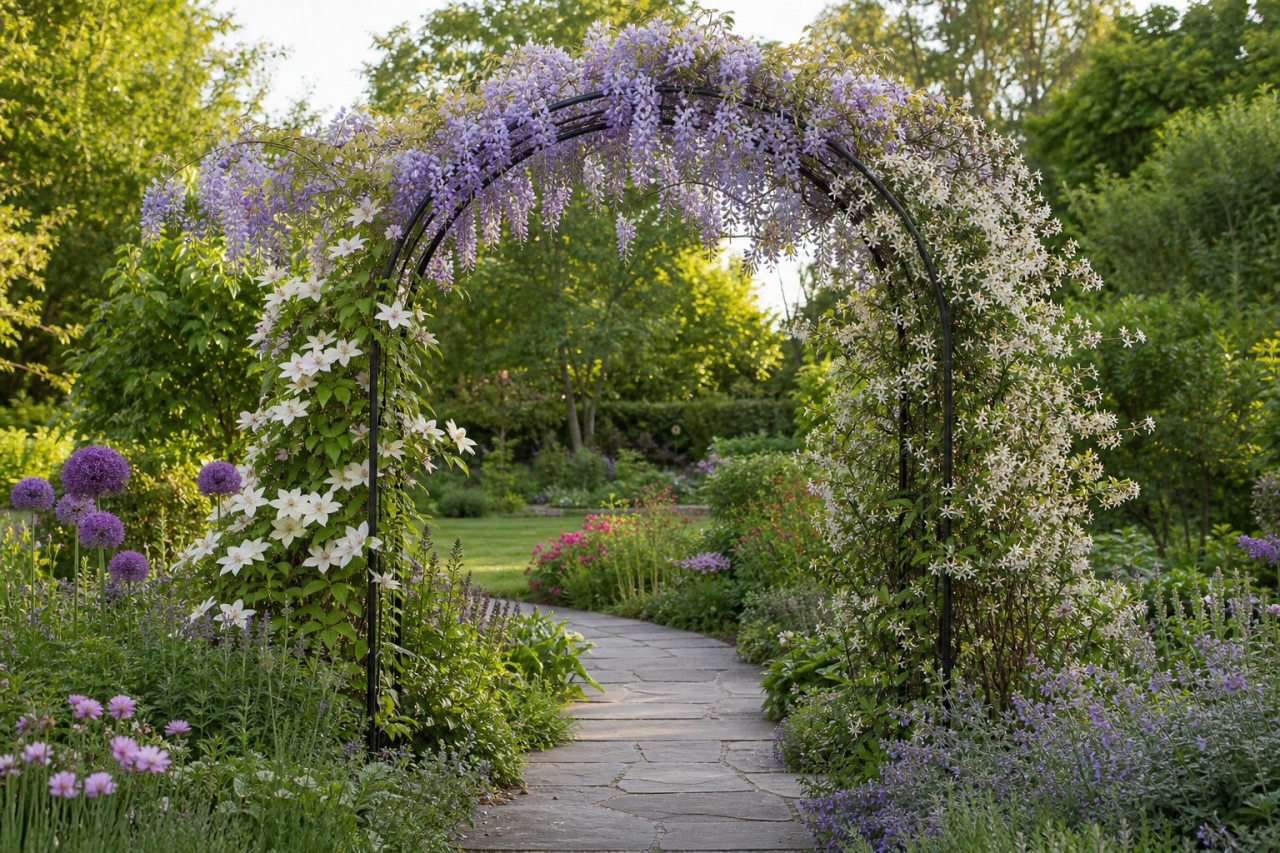
Wisteria looks magical draping from a metal arch in May. It is also a structural beast. A mature wisteria can apply enough force to deform a lightweight frame, lift bolts and pull at anchoring points. Wisteria belongs only on truly heavy-duty steel structures with deep ground anchors, and even then it benefits from an annual hard prune to control mass. For most domestic arches, wisteria is better trained on a wall.
Honeysuckle, jasmine and quieter options
Not every arch needs to be a showpiece. Star jasmine offers evergreen leaves, intense summer fragrance and a polite growth habit that suits doorways and patios. Honeysuckle ('Lonicera periclymenum') brings nostalgic scent and supports pollinators. For shadier positions, climbing hydrangea covers metal beautifully without demanding full sun. The general rule across all of these is simple: two compatible climbers per arch, planted one at each leg, allowed to meet at the top over two or three seasons. The frame disappears, and the garden gains a living arch that looks as if it has always been there.